


 Cart
Cart
 sales@molnova.com


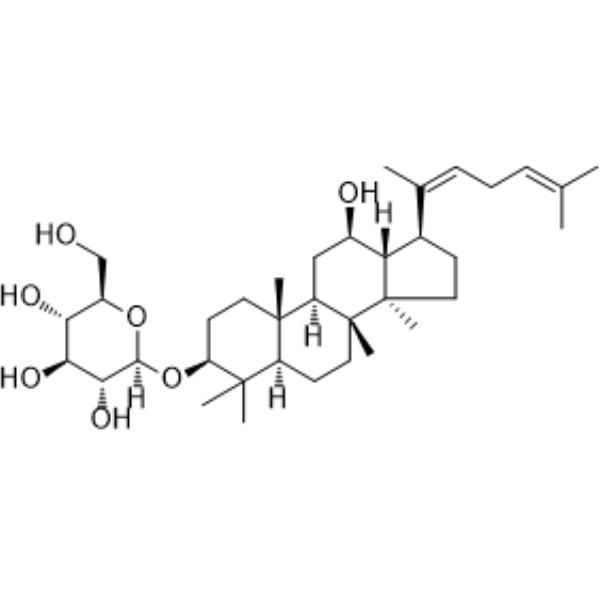
Ginsenoside Rh3
CAS No. 105558-26-7
Ginsenoside Rh3( —— )
Catalog No. M30894 CAS No. 105558-26-7
Ginsenoside Rh3 is a natural product extracted from Ginseng C. A. Mey.Ginsenoside Rh3 has antifungal and antioxidant activities and induces Nrf2 activation in human retinal cells.
Purity : >98% (HPLC)
 COA
Datasheet
HNMR
HPLC
MSDS
Handing Instructions
COA
Datasheet
HNMR
HPLC
MSDS
Handing Instructions
| Size | Price / USD | Stock | Quantity |
| 5MG | 331 | In Stock |


|
| 50MG | Get Quote | In Stock |
|
| 100MG | Get Quote | In Stock |
|
Biological Information
-
Product NameGinsenoside Rh3
-
NoteResearch use only, not for human use.
-
Brief DescriptionGinsenoside Rh3 is a natural product extracted from Ginseng C. A. Mey.Ginsenoside Rh3 has antifungal and antioxidant activities and induces Nrf2 activation in human retinal cells.
-
DescriptionGinsenoside Rh3 is a natural product extracted from Ginseng C. A. Mey.Ginsenoside Rh3 has antifungal and antioxidant activities and induces Nrf2 activation in human retinal cells.
-
In VitroGinsenoside Rh3 inhibits UV-induced oxidative damages in retinal cells via activating nuclear-factor-E2-related factor 2 (Nrf2) signaling. Ginsenoside Rh3 treatment in retinal cells induces Nrf2 activation. The potential activity of Ginsenoside Rh3 is tested on Nrf2 signaling in the retinal pigment epithelium cells (RPEs). The qRT-PCR assay results demonstrate that treatment with Ginsenoside Rh3 dose-dependently increases mRNA transcription and expression of key Nrf2-regulated genes, including HO1, NQO1 and GCLC. Consequently, protein expressions of these Nrf2-dependent genes (HO1, NQO1 and GCLC) are also significantly increased in Ginsenoside Rh3 (3-10?μM)-treated RPEs. Notably, although Nrf2 mRNA level is unchanged after Ginsenoside Rh3 treatment, its protein level is significantly increased by Rh3. EZ-Cytox assay is used to assess the effect of ginsenoside-Rh3 on SP 1-keratinocytes viability. Ginsenoside Rh3 (0.01, 0.1, 1 and 10 μM) shows no cytotoxic effect at all concentrations.
-
In VivoThe potential effect of Ginsenoside Rh3 is examined on mouse retina, using the light-induced retinal damage model. Ginsenoside Rh3 intravitreal injection (5?mg/kg body weight, 30?min pre-treatment) significantly attenuates light-induced decrease of both a- and b-wave amplitude. The electroretinography (ERG)'s a-wave decreases to 46.03±1.62% % of control level after light exposure, which is back to 71.84±7.51% with Ginsenoside Rh3 administration. The b-wave is 40.19±3.34% of control level by light exposure, and Rh3 intravitreal injection brings back to 80.01±2.37% of control level.
-
Synonyms——
-
PathwayOthers
-
TargetOther Targets
-
Recptor——
-
Research Area——
-
Indication——
Chemical Information
-
CAS Number105558-26-7
-
Formula Weight604.86
-
Molecular FormulaC36H60O7
-
Purity>98% (HPLC)
-
SolubilityIn Vitro:?DMSO : 6.67 mg/mL (11.03 mM)
-
SMILES——
-
Chemical Name——
Shipping & Storage Information
-
Storage(-20℃)
-
ShippingWith Ice Pack
-
Stability≥ 2 years
Reference
molnova catalog



related products
-
N-Acetyl-α-Endorphin
N-Acetyl-α-Endorphin is an acetylated α-Endorphin at N-terminal. α-Endorphin is an endogenous opioid peptide.
-
Furimazine
Furimazine is an imidazopyrazinone substrate. NanoLuc (Nluc) paired with Furimazine produced 2.5 million-fold brighter luminescence in mammalian cells relative to Oluc-19 with Coelenterazine.
-
SIVmac251 (gp140) Fr...
SIVmac251 (gp140) Fragment (171-190) [Cys]
